
Are you weighing whether your problem could be solved by some app? But how do you decide when to buy something that already exists — a "ready-made product" or SaaS (Software as a Service) — and when it's better to invest in building something custom for you?
The right approach usually depends on whether the problem will be solved fully or only partially. Then on long-term cost and sustainability, switchability, ease of use, technical support, and many other factors. How and where do you even start the decision? What pays off in which case?
In the article What decisions usually wait for you when deploying AI I briefly described Build vs Buy vs Integrate as one of the four main choices when deploying AI. This article is a deep-dive on that first fork — when to rent software, when to build it. The framework is universal for any software decision, but with AI tools it matters more, because a third path appeared — integrating existing components into your own systems. I'll come back to that at the end.
It's a lot like real estate
When you choose between renting and buying property, you weigh what you can afford, your long-term plans, the available options, financing, market conditions, and other factors.
Imagine you're buying property on a mortgage. The monthly loan payment is 2,000 CZK lower than rent. So at first glance it pays off — in 30 years you own it, the property value can grow, and over time you can be a few millions richer. But a whole range of events can devalue the asset or force a move.
Both options carry risk — a renter usually pays more long-term and isn't their own master, but an owner carries obligations and has substantially less flexibility when things change.
How does this relate to IT?
A lot. The real-estate parallel applies here too, because you decide based on your needs, options, and circumstances. The main difference is the speed of market change. That brings more complex criteria when picking the right application:
-
Industry maturity — the volume of innovation and its impact differ by sector. Generally, in critical infrastructure (e.g. public sector or energy) decisions tend to be more conservative because of risk. Conversely, companies in less critical sectors (e-commerce, advertising) have less societal impact and can therefore experiment more.
-
Switchability — anyone can change their needs and requirements overnight. For companies the trigger might be growing 1,000% in a short time. In both cases you need to weigh flexibility, adaptability, and modularity. If those characteristics are weak, at least consider how easy it would be to switch to a different solution.
-
Budget — the price range in IT is much broader than in real estate. You can rent software for 200 CZK a month, or for 1 million CZK a month. Custom development scales similarly across orders of magnitude. Assuming you're not looking at a stopgap, the same rule applies as with real estate — think long-term.
There are many approaches to choosing a solution. Now I'll focus on the pros and cons of the two main paths.
Better not to reinvent the wheel — rent it?
For these reasons the term "as a Service" emerged — renting a product. In software it's SaaS, typically aimed at solving common problems "turn-key". Like with renting property, you don't own SaaS. You just have permission to use it and pay a recurring fee for that.
Main advantages of SaaS:
- Lower upfront cost — you only pay a monthly or annual fee, so you don't have to invest in software development or hardware.
- Quick deployment — turn it on and use it. You don't wait weeks, months, or years for the problem to be solved.
- Continuous updates — you don't have to worry about new versions and security patches. Providers handle that automatically, so you always have an up-to-date tool.
- Scalability — SaaS solutions usually expand and adapt to the needs shared by most active users.
- Customizability — different user groups have different needs. That's why SaaS packages, tabular specs, and configurators emerged — letting you tailor an app's functionality and price to a wider audience.
When to choose to rent (SaaS):
- When a highly standardized, user-validated solution exists that adequately solves your general problem.
- When the long-term cost of existing apps is lower than building a custom solution.
- When it's better to pay only for "what you actually consume" instead of paying high upfront costs.
- When your needs change often and significantly — so you can easily switch to an alternative solution.
- When your problems aren't too specific, so you don't need much customization.
Examples of SaaS solutions:
- Web browsers
- Cloud services (remote storage)
- Antivirus programs
- Email services
- General ERP or CRM systems
Where to read more:
- Switching to SaaS is a strategic change (Tomáš Svoboda)
- SaaS — the worst thing that happened to your business process (Jan Mazal)
- Can the SaaS model be a disappointment? (Pavel Jiruš)
- Compare custom and template Shoptet (Petr Hejčl)
You can't please everyone, though. If a user group doesn't meet the criteria above and has processes specific and complex enough that a turn-key solution would actually hurt — they need their own path.
Investing in your own software, under your control
Back to real estate. If you're clear you don't want to rent and will buy something, you usually have several options — buying a finished property without renovation, buying with renovation, a template build, custom build, turn-key, shell-and-core, building yourself or with a contractor, and many more.
Before you start building, you usually do a small survey. You check what's already built and on the market in the area, what planned or in-progress projects might match your needs, what land is for sale along with contractors and craftspeople.
It's also key to move in as soon as possible and base secondary decisions on living there — furniture, terrace size, pool placement. You can plan everything ahead, but daily needs and their priorities will shift. You usually don't have the budget for everything at once, and start with only the bare minimum and add more over time.
Similar principles apply in IT. Hence the advantages of custom development:
- Ownership — you usually have full rights to what gets built. Watch licensing and acquisition though, as in the Czech Republic the author of the software is automatically the owner.
- Maximum control — you have full control over functionality. You get what you actually need, no missing or unnecessary features.
- Tailored fit — software matches your needs, especially valuable for specific processes or integration with existing internal systems.
- Vendor independence — if a SaaS provider stops the service overnight, you have a problem — you have to find a completely different solution. With your own application you only switch vendors. Caveat — if the original vendor didn't build with sufficient quality and documentation, handover can be hard.
When to choose custom development:
- The market has no alternative or it's very limited, insufficient and non-standardized without broad user validation.
- Long-term rent costs don't match the price/performance vs. building your own software, for which you have capital.
- You have many specific, complex requirements that change often and need to be reflected operationally.
- You work with sensitive data that you only want to share with parties you approve.
- You want to solve a previously unsolved problem with unique value-add for the market, not just for your own need.
Examples of situations for custom development:
- A startup app with an innovative solution
- Tightly specialized software
- Integration of internal systems
- Extensions to existing software
Where to read more:
- ERP: Does it make sense to build your own resource management system? (iQuest)
- 6 reasons to develop a mobile app (Kristýna Lang)
- 8 things before signing a custom-software contract (Michal Ohrablo)
- Switching from a packaged web solution to a custom one (Ondřej Hájek)
Economic comparison of rent vs. custom
Long-term, custom software development can have a better return on investment. The examples below are only an illustrative economic comparison from practice. They don't account for the volume of possible customizations, your time and effort spent on the build, support quality, and other key aspects.
Example 1: An e-shop for consumer products
The most common situation where this decision arises in the Czech Republic is e-shops. Let's compare the typical options — e-commerce platforms like Shoptet, Shopify, or WordPress WooCommerce vs. template custom development vs. fully custom.
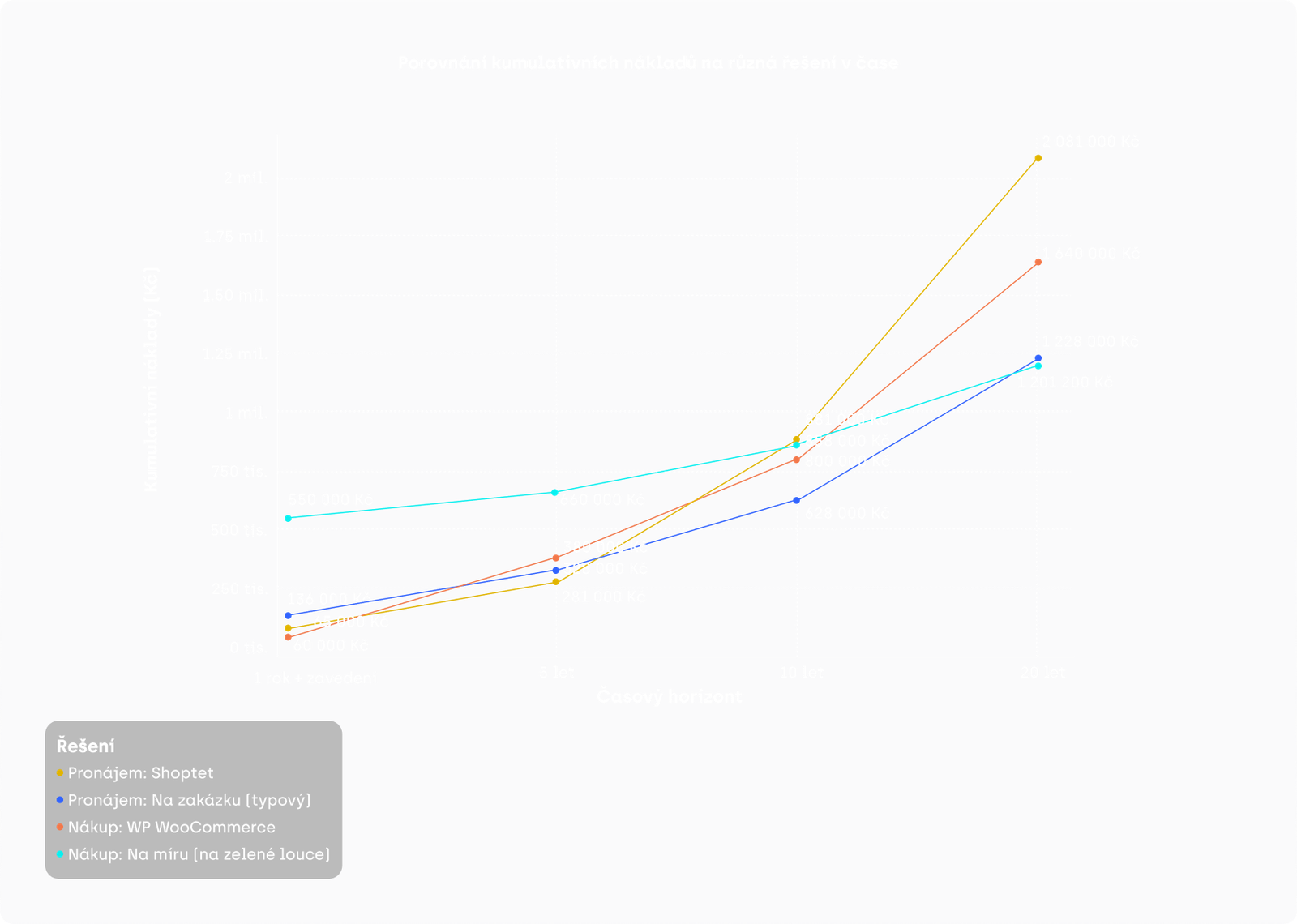
The simulation might suggest that building custom pays off. But factoring in your own time, "custom-template rental" or, for risk minimization, "Shoptet rental" might be a better fit. In any case, prices over the long run are quite comparable and many other factors will matter. The following article reviews one of the tools: Shoptet tool: price, features, experience (Lukáš Martínek).
Example 2: A food delivery system
Now imagine you have a company that needs software for food delivery. Say it's growing fast and already has many users. Most existing solutions charge high per-user fees. What might the financial costs look like in an extreme case?
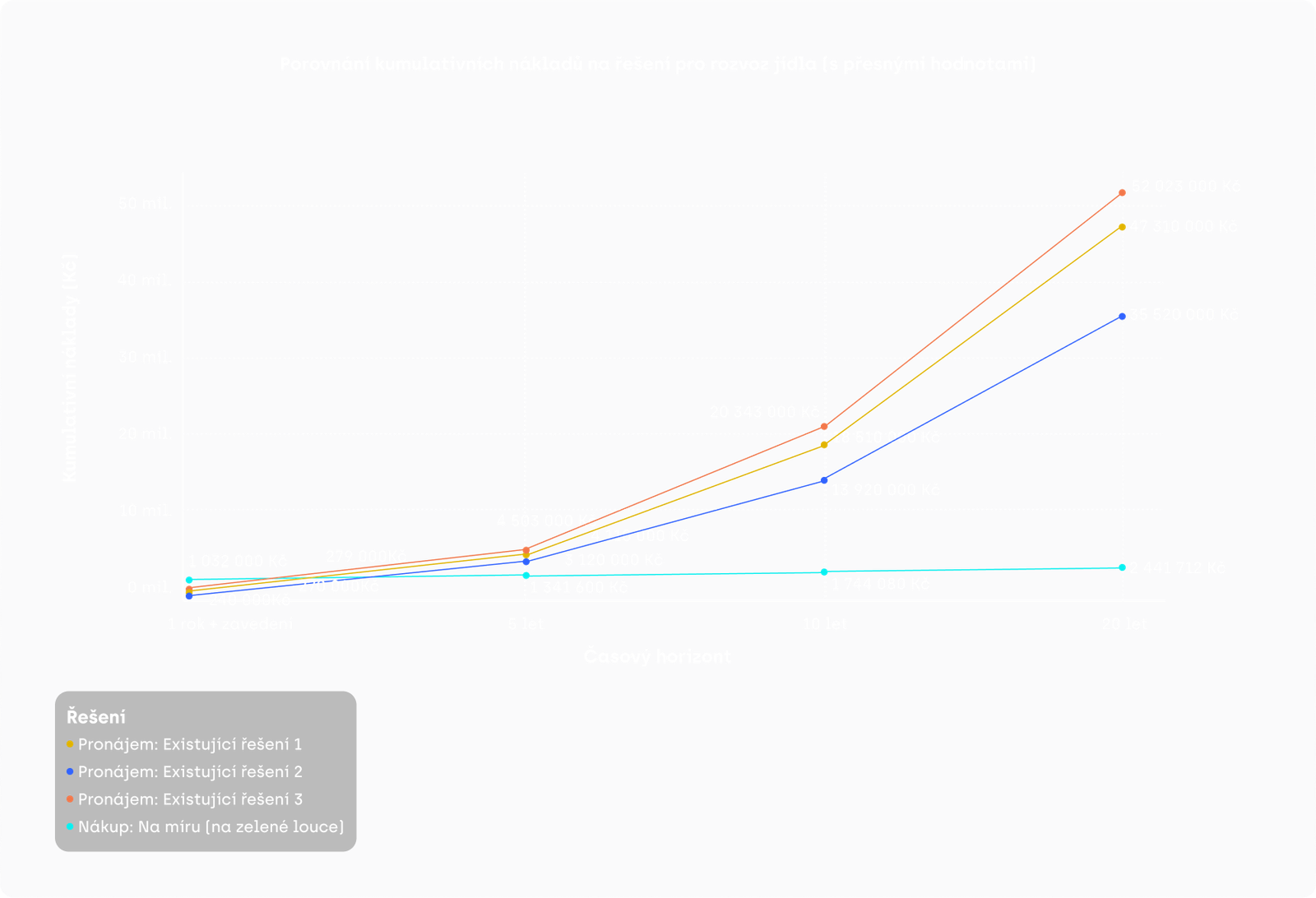
The second example isn't sci-fi — it's an illustrated real case. Why do many entrepreneurs go with "rental of existing solution 2" instead of greenfield development, even when the gap is so large? Many reasons; from my experience, most often these:
- Lack of knowledge and experience in this area leads to fear of unknown risks.
- Custom in-house development requires your own time and effort.
- Insufficient capital for the upfront investment, in exchange for lower long-term cost.
- A short-term cashflow lens instead of a long-term one.
- Past bad experiences with software development.
- Business viability uncertainty leads to planning only for a limited horizon.
- Worry about a long-term commitment that will keep needing internal time.
- Treating in-house IT as a borderline necessary evil instead of an investment in the future.
So what?
From this, you can't say in general which path is financially better in a specific case. Companies also evolve over time — both in process complexity and size. So you always have to decide based on demonstrable information about needs, problems, and options for the situation.
A third path in the AI era: Integrate
When I wrote the original version of this article in 2024, the framework was binary — rent or build. With AI tools, a third path emerged worth mentioning: integrate.
Integrate means taking existing components (often SaaS, often AI) and connecting them with your systems into a functional whole through an orchestration layer. Concrete example: instead of building your own AI agent from scratch or paying full price for a ready-made platform, you use Claude.ai or the OpenAI API as the core, n8n as orchestration, your own data as the knowledge base, and put a thin custom layer around it for your specific workflow.
The integrate pattern has its advantages:
- Faster than build, more flexible than buy — you ship a working solution in weeks, not months, and keep more control than with SaaS.
- Component swappability — when the AI market changes every two weeks, the ability to swap one model for another without rewriting the whole is critical.
- Lower vendor lock-in — you don't depend fully on one SaaS provider.
For AI projects, integrate is often the best starting point today — build the first version by connecting existing components, validate that it works, and only then decide whether to go deeper into custom. More on that in What decisions usually wait for you when deploying AI.
Summary
The choice between renting software and investing in custom is a complex process where the right path isn't always obvious. It depends on the quality, relevance, and recency of existing solutions, the specificity and importance of requirements, the expected volume of change, the upfront budget, and many other factors.
Larger companies and corporates usually prefer custom for specific processes, data control, and lower long-term costs. Smaller and mid-sized companies mostly rent because they pivot more, change more, and need to watch short-term cashflow first. In both cases you can handle related services — research, support, project management, or legal — through outsourcing.
For AI projects, integrate is worth considering as the starting point — a working solution built from existing components gives you fast validation and flexibility before you decide on full build or full buy.
Whichever path you pick, there are usually many ways to cover the problem technically. But before you go down one road, it's worth consulting an expert in the area — and not deciding only based on who put on the loudest sales show at supposedly the lowest price.
If you're working on a similar decision at your company and want an independent view of which path could make sense for your specific situation — I'd be glad to talk it through.
/ Terms in this article /