

Wondering whether an off-the-shelf application could solve your problem? The real question is harder: how do you decide when to buy something that already exists (a packaged product, or SaaS, Software as a Service) and when you are better off investing in something built for you?
The right path usually turns on whether the problem gets solved fully or only partially. Then on long-run cost and maintainability, switching risk, ease of use, vendor support, and a dozen other factors. Where do you even start, and what actually pays off in which case?
In the article What decisions usually wait for you when deploying AI I framed the buy-vs-build choice as one of the core decisions firms face when adopting AI. This piece is the deep dive on exactly that fork: when to rent software and when to build it for yourself. The framework is general for any software decision, not only AI.
It works much like real estate
When you choose between renting a home and buying one, you weigh what you can afford, your long-term plans, the options available, financing, the state of the market, and more.
Picture buying a property with a mortgage where the monthly payment runs a little below comparable rent. At first glance it pays off: in 30 years you own the asset, its value may rise, and you could end up meaningfully wealthier. Yet plenty of events can intervene, eroding the asset's value or forcing you to relocate.
So both options carry risk. A tenant usually pays more over time and is not their own master; an owner carries the obligations and has far less flexibility when things need to change.
How this maps to software
Closely. The real-estate comparison holds because you decide based on your needs, your means, and your circumstances. The main difference is the pace of the market and the rate of change that comes with it. That adds more demanding criteria when picking the right application:
-
Industry pace: the volume of innovation and its impact differs by sector. In critical infrastructure (public sector, energy) decisions tend to stay conservative because the risks are high. Firms in less critical sectors (e-commerce, advertising) have lower societal impact and can experiment more.
-
Switching likelihood: anyone can change their needs and expectations overnight. For a company that can mean changing in size by 1,000% in a short window. In both cases you have to weigh flexibility, adaptability, and modularity. If a solution lacks those, at least assess how hard it would be to move off it later.
-
Budget: in software the price range is far wider than in real estate. You can rent software for tens of dollars a month, or for tens of thousands. The same scaling applies, an order of magnitude up, to building one. Unless you are after a stopgap, the real-estate rule holds: think about it over the long run.
There are many ways to approach the choice. Here I focus on the trade-offs of the two main paths.
Don't reinvent the wheel, just rent?
This is why the "as a Service" model emerged: renting the product instead of owning it. For software that is SaaS, usually aimed at solving standard problems turnkey. Like renting a home, you do not own SaaS. You hold a license to use it and pay a recurring fee for that.
Main advantages of SaaS:
- Lower upfront cost: you pay only a monthly or annual fee, so you avoid investing in development or hardware.
- Fast deployment: turn it on and use it. No waiting weeks, months, or years for a solution.
- Continuous updates: you do not manage new versions or security patches. The provider handles that automatically, so the tool stays current.
- Scalability: SaaS products typically expand and adapt to needs shared by most active users.
- Configurability: different user groups have different needs, so packages, tiered specs, and configurators let a product flex on features and price for a broader audience.
When to rent (SaaS):
- A highly standardized, user-proven solution exists that adequately solves your general problem.
- The long-run cost of existing applications is lower than building custom.
- It is better to pay only for what you actually consume than to carry a high upfront cost.
- Your needs change often and substantially, so you want to switch to an alternative easily.
- Your problems are not highly specific, so you don't need much customization.
Examples of SaaS:
- Web browsers
- Cloud services (remote storage)
- Antivirus software
- Email services
- General ERP or CRM systems
You cannot please everyone. If a user group does not meet the criteria above and has processes specific and complex enough that a turnkey solution does more harm than good, it needs its own path.
Investing in custom software you control
Back to real estate first. Once you are sure renting is out and you want to buy, you usually have several routes: a finished property needing no work, one requiring renovation, a standard build, a custom build, turnkey, shell construction, DIY, or with a contractor.
Before you build, you usually do some homework. You look at what is already built and for sale nearby, which planned or in-progress projects might fit your needs, and which plots are available along with the firms and trades to realize them.
It is also usually key to move in as soon as possible and make many secondary decisions accordingly: furniture, terrace size, where the pool goes. You can plan it all upfront, but daily needs and priorities then shift. You rarely have the budget for everything at once, so you start with the bare minimum and add the rest over time.
The same principles apply in software. From them come the advantages of building:
- Ownership: you usually hold full rights to what is created. Watch the licensing and rights-assignment terms, since by default the author owns the software in many jurisdictions, including the EU.
- Maximum control: full control over the functionality. You get what you actually need, without missing or superfluous features.
- Tailored fit: the software matches your needs, which matters for specific processes or integration with existing internal systems.
- Provider independence: if a SaaS vendor stops providing or maintaining the service overnight, you have a problem and must find an entirely different solution. With your own application you only switch suppliers. Caveat: if the original supplier did not build it with adequate quality and documentation, handover can be hard.
When to build:
- There is no alternative on the market, or it is very limited, sub-standard, and not validated by a broad user base.
- Long-run rental spend does not match the price/performance of building, and you have the capital for it.
- You have many specific, complex requirements that change often and must be reflected operationally.
- You work with sensitive data you only want to share with parties you approve.
- You want to solve a so-far-unsolved problem with differentiated value for a market, not just for your own use.
Situations that call for building:
- A startup app with an innovative solution
- Narrowly specialized software
- Internal-systems integration
- Extending existing software
The economics: renting vs building
Over the long run, building custom can have the better return. The examples below are purely illustrative economics from practice. They do not account for the volume of customization, your own time and effort, support quality, and other decisive factors.
Example 1: an e-commerce store for consumer products
The most common case where this decision comes up is online stores. Compare typical options: e-commerce platforms like Shopify or WordPress WooCommerce versus standardized custom builds versus fully custom development.
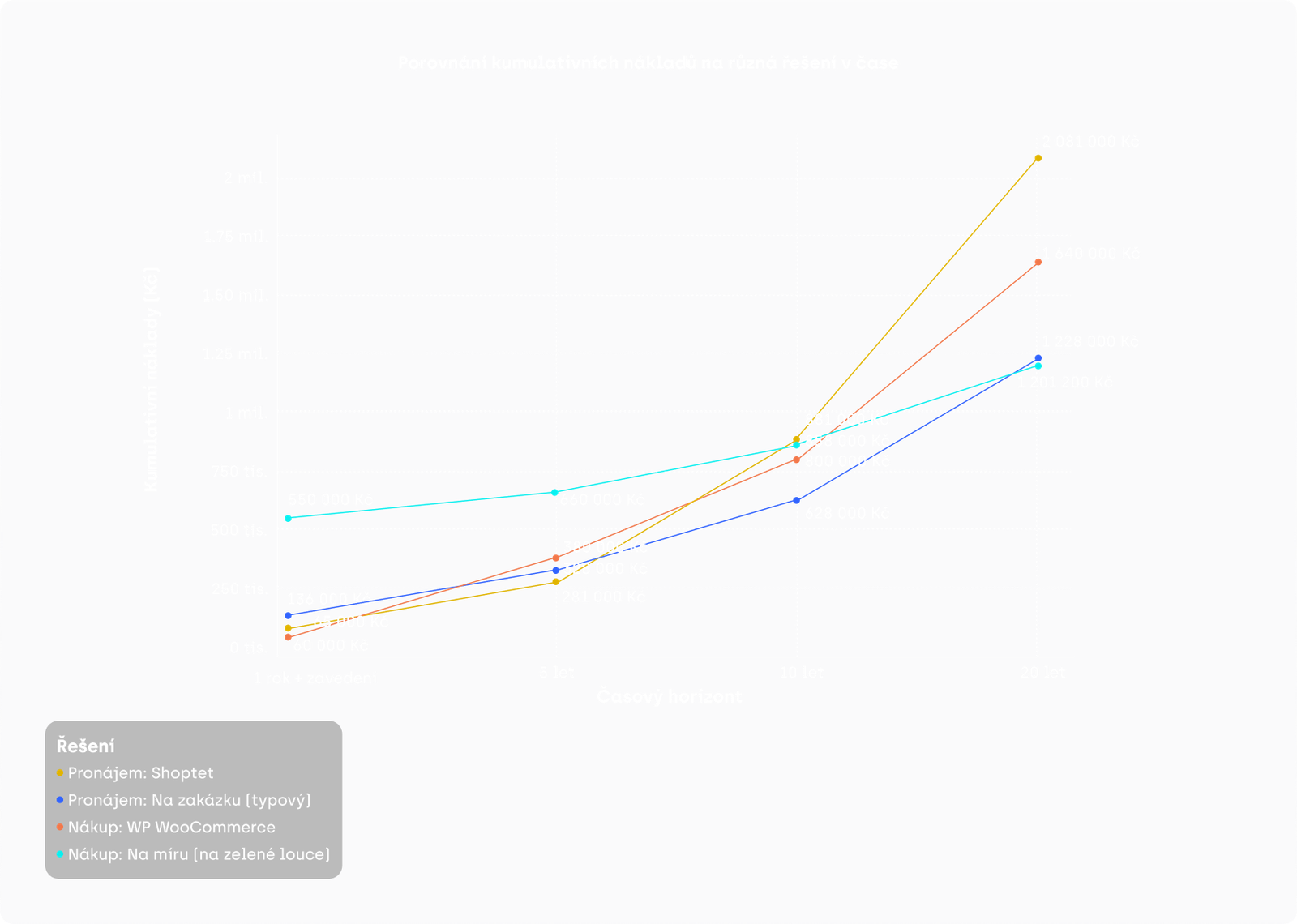
The simulation can make a custom build look like the winner. But once you factor in your own time, a "standardized custom rental" or, to minimize risk, a hosted platform may be the better call. Over a long horizon the costs are broadly comparable and many other factors dominate.
Example 2: a food-delivery system
Now picture a company that needs software for food delivery. Say it grows fast and already has many users. Most existing solutions charge steep per-user fees. What might the finances look like in an extreme case?
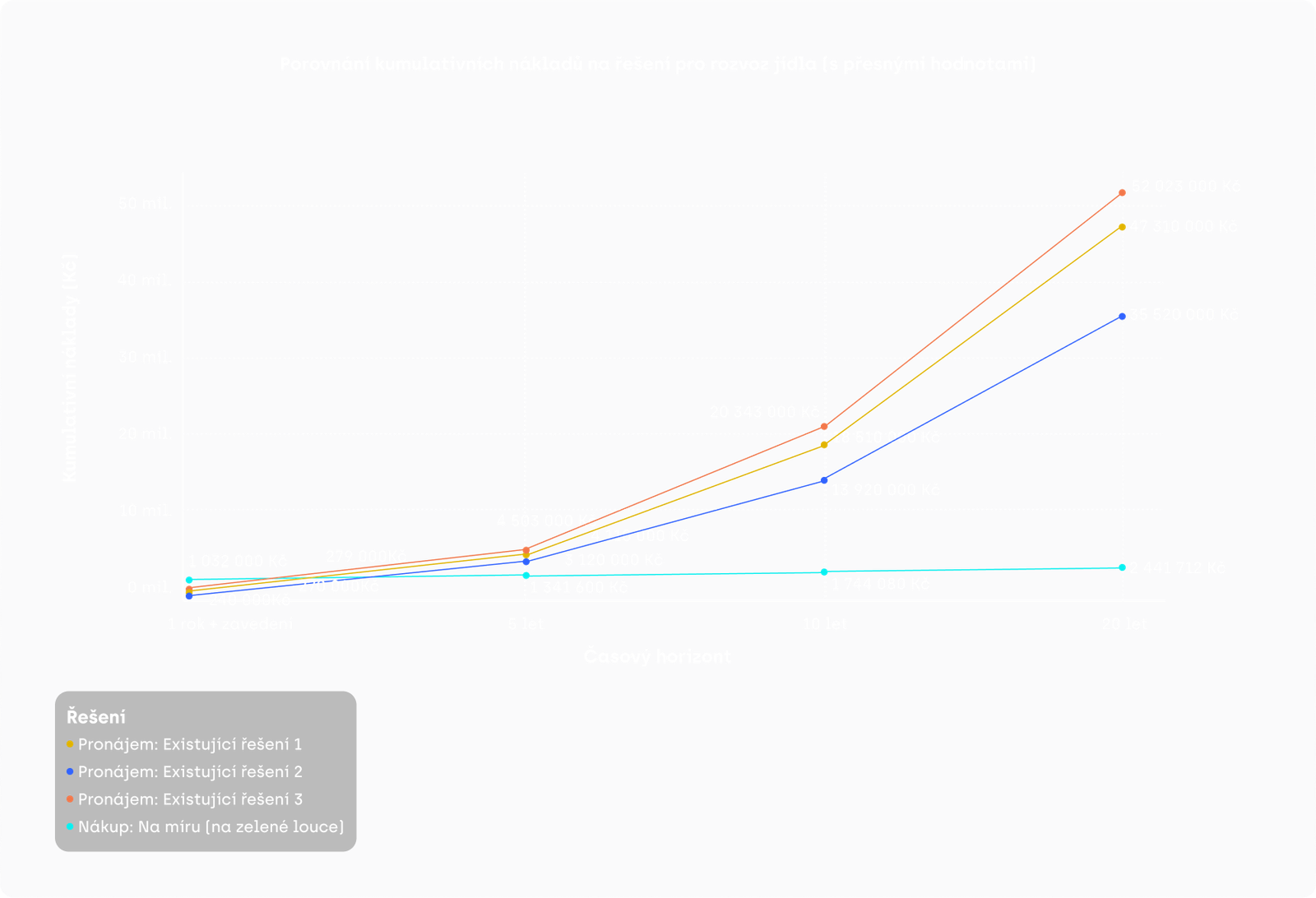
The second example is not science fiction; it is an illustrated case from practice. Why do many operators reach for "existing solution 2" instead of a greenfield build even when the gap is that large? Many reasons. From experience, most often these:
- Limited knowledge and experience in the area, which breeds fear of unknown risks.
- The effort and time a custom solution demands of you.
- Insufficient capital for the upfront investment, at the expense of lower long-run cost.
- A short-term cash-flow lens instead of a long-term one.
- Prior bad experience with software development.
- Business viability that argues for planning over a limited horizon only.
- Fear of a long-term commitment that will keep requiring internal time.
- Seeing in-house software as a marginal necessary evil instead of an investment in the future.
What follows from this
From the above you cannot say in general which path is financially better in a specific case. Every firm also evolves and changes over time, in process and in size. So always decide on demonstrable information about your needs, problems, and options for the situation at hand.
Summary
Choosing between renting software and investing in a custom build is a complex process, and the right path is rarely obvious. It depends on the quality, relevance, and currency of existing solutions, on how specific and important your requirements are, on the expected volume of change, the upfront budget, and many more factors.
Larger firms and enterprises usually prefer custom because of specific processes, data control, and lower long-run cost. Smaller and mid-sized firms more often rent, because they pivot and change more and need to watch near-term cash flow. In both cases you can handle related services such as discovery, support, project management, or legal through an outsourcing approach.
Whichever way you go, there are usually many ways to cover the problem technically. Before you commit, it pays to consult a specialist in the area. For a larger investment, a structured comparison of the options belongs in solutions architecture; don't decide by who staged the slickest sales theater at the supposedly lowest price.
This choice is not new and mattered long before AI. With AI tooling it gained weight, because the cost side of building shifted hardest. The framework above still holds; what moved is when each path pays off. What AI did to that equation is the subject of the article SaaS vs Vibe Coding: What AI Changed (Part 2). For the wider map of decisions you face when adopting AI, see the article What decisions usually wait for you when deploying AI.
If you are weighing a similar decision and want an independent read on which path fits your specific situation, I am happy to talk it through.
Schedule a 30-min discovery call →
/ Terms in this article /


